Since Philips announced their split in late 2014 their lighting division's annual sales have fallen by 3% to a mere $6.9 billion for the last year. CEO Frans van Houten has commented to investors that the North American division's performance was 'unsatisfactory' and because of this he has appointed Amy Huntington as the new head of North America's lighting business. He also commented that China's sales had also dropped due to deteriorating market conditions. This is different to the wider divisions performance which has continued to grow rapidly due to selling of LED-based solid-state lighting products in addition to a contract to replace the entire street lighting system of Madrid. Philips is also planning to sell the automotive lighting unit in addition to Lumileds, the LED chip making branch. Lumileds commented that, 'The company is in discussion with external investors for the combined Lumileds and automotive lighting businesses and expects to complete translation in the first half of 2015.' These two divisions composed of 8300 employees have delivered sales of $1.4 billion. Madrid project Philips has estimated that the market for high-power LEDs will grow at an annual growth rate of 17-21% up to 2018, whilst the growth of the the overall lighting market is estimated to be 3-5%. The lighting industry is rapidly transforming from inefficient products to highly efficient goods and now demands extreme innovation. The CEO has claimed that Philips is outlaying over 30% more than its closest competitor in research and development to set a higher pace of technological advancement. Van Houten expects that the emerging market of data-enabled lighting systems will expand the overall market by roughly $1 billion in the next few years. Whilst all this is going on, Philips have undertaken a monumental project to replace street lighting in Spain, Van Houten commented that, 'We signed a contract to provide the city of Madrid with what is the world's largest street lighting upgrade to date, involving the replacement of 225,000 luminaries.' He also commented that the new system would create a saving of 40% in energy which would mean the installation cost would be paid back almost instantly and mean no extra cost to Madrid's citizens. The new system is said to feature an 'integrated command centre' which means that the entirety of the street lighting system could be controlled by a single control point. Another project that is set for the future will see the distribution of 1.5 million Philips LED lamps in India to over a million households. This should cut lighting energy consumption by 80% and would save 80 MW in electricity generation. With these projects Philips lighting is looking to have a prosperous year ahead but 2015 will present challenges due to the $400 million in costs due to the split and reconstruction of the company. |
Monday, 23 February 2015
'Largest Street Lighting Upgrade' Signed by Philips


Monday, 16 February 2015
Is The Light Switch Becoming Extinct?
The LED lamp has got a pretty certain future but with the way that technology is changing so rapidly, how much longer will the humble light switch last?
Lux Magazine's James Holloway has looked into what the future holds for Light Switches and proposes five things that could replace the switch
1. Gestures
The idea behind gesture controlled lighting is pretty simple. Why have to always travel to the light switch to turn a light not when you could wave at it from the comfort of your seat. As a matter of fact, the technology already exists to make gestured lighting controls. An example already being produced is Ubiquilux's 'e-Motion', in which you wave up and down to turn a light on or off, but also you can wave side to side to adjust brightness.
One reason to change to this type of switch is purely due to cleanliness, with less physical contact with a switch, germs won't be passed on as easily, extremely useful in hospitals. What is unsure is how close you would need to be for your gesture to turn the light on, if you need to be very close, whats the point? You may as well have a switch! if further away, surely your normal movements could be confused for a light switching gesture.
2. Voice Control
Our phones, computers and tvs can now all be controlled by our voice so why not our lighting? 'Vocca' is a new voice activated light bulb adaptor which simply screws in between your lamp and its housing. It can work with any lamp and adds on a minuscule 0.25W of power. Finding it hard to see the downside? Imagine someone listening in on your private conversations, scary.
3.Presence Detection
Motion detection is getting on a bit now but the problem with it is, if you're sat reading a book in the comfort of your own home, you're likely to be sitting still, and the problem with sitting still and lights powered by motion detectors is that they will turn off. 'Zulu' is a new product that aims to tackle this issue, it is a wireless power adaptor that connects to your phone via bluetooth. This detects your presence inside your home and in certain rooms, it doesn't matter whether you are moving or sitting perfectly still, the light will stay on as long as you are in the room. No more standing up and waving erratically when you get plunged into darkness mid sentence.
4. Apps
We are all pretty familiar with the Philips Hue, an app which allows you to control your lighting from your tablet or smartphone through bluetooth or Wi-Fi. Not only can you control whether your light is on or off, you can dim your lighting or even chose your favourite colour to light the room. Although we automatically reach for our phone for practically everything we do, is digging your phone out and finding the correct app really much easier than just flicking a switch?
5. Smart Home Hubs
Smart homes are the most smart when all systems can communicate with each other. A way to do this is to put a smart thermostat in your home. Google's 'Nest' is the ideal smart home hub as it can do more than just control your lighting, combined with a smart alarm system, you could set your lights to turn on at a particular level when your alarm system is activated and you are not at home. Other systems can make your lights flash when carbon monoxide levels are too high. Very clever but the technology still needs to improve to learn people's preferences
Is the noble light switch facing extinction after all?
All of the new technologies above are extremely innovative and we can't see any reason why they could not become part or our everyday lives. However, as impressing as they all are, it is more likely that they will enhance the light switch rather than supersede it. Although, this point of view may not last for ever. We are always looking for a simpler way to do things and our expectations of technology are getting higher and higher. Maybe light switches will become extinct sooner than we expect.
Friday, 6 February 2015
Demand Side Energy Benefits Are (almost) Invisible to UK Government.
 (image courtesy of ADE website)
A report carried out by the ADE (Association for Decentralised Energy) has shown that the UK is saving billions of pounds per year due to the invisible benefits of reduced energy demand. Over the last thirty years we are doing a lot more but with a lot less.
The ADE represents the heat and power industry and claims that producing energy locally and using it more efficiently saves consumers over £37 billion per year compared with 1980.
The report looked at local energy generation and energy saving schemes such as LED lighting switchovers, such actions have helped the UK to avoid building 14 new power stations, which equals the same as the country's current power generating capacity.
The ADE stated in its report that 'invisible' benefits are often discounted as policymakers are focusing on energy supply rather than demand.It continues to say that it is easier for politicians to make big changes and evaluate on a bigger scale rather than looking into the finer detail of demand changes taking place across the country.
Lighting industry figures have come to similar conclusions of the government's approach to energy, promoting that more time and attention needs to be put into reducing demand, rather than boosting capacity and moving to renewable energy sources.
Last year Lux Magazine developed its own ideas of how capacity could be reduced if low-energy lighting was more widely used.
The ADE wants energy demand to be put in the spotlight as the focal point of future policy making. Director, Tim Rotheray said, ' Actions on the demand side have helped keep Britain's lights on, making the UK a better place to do business by keeping energy supplies consistent and reliable… Despite these considerable achievements, new energy policy often repeats the same patterns, taking a centralised approach to solving the energy challenge and overlooking the substantial contribution that users and individual actions can make.
‘With a clear, simple policy approach that values these smaller contributions, demand-side services can help consumers do even more to cut waste, improve competitiveness and reduce emissions. By 2020, we could save consumers a further £5.6 billion and make the UK a more attractive place to do business.
‘Adopting the right policy could mean that by 2020 we could save enough power to run the London Underground for 30 years, equivalent to 45 TWh (45 billion units). Further reduction in energy demand will make the UK more secure and enable greater energy independence.’
For more information on the ADE's report, click here.
Led lighting switchovers are an excellent way to reduce the demand for energy, please go to our website The LED Specialist and start making your home more energy efficient,
Help reduce energy demand!
Thursday, 29 January 2015
SNAP! - The Lightbulb That Doubles As A Camera
US Company SENGLED have debuted a smart LED lamp that also functions as a high resolution camera, microphone and speaker. This lamp is supposed to act as a subtle home security and monitoring system designed to de-clutter your home from multiple leads and cables and keep things all in one place. This lamp streams a video to your smartphone or tablet through its app and allows the user to view videos in real time.

(Pictures courtesy of SENGLED and Yahoo)
Snap is another highly functional lamp that SENGLED have added to their collection, some of their other innovations include a lamp that doubles as a wireless speaker as well as a lamp that also functions as a Wi-Fi repeater to boost signal to the blackspots in your home.
Unfortunately the Snap is yet to be released or priced, but it is expected to come to market this summer. Stay tuned for more info about this bright little lamp!

Thursday, 15 January 2015
'Bring the Sun Indoors'
New Lighting Company Creates Lighting that Mimics the Sun and Moon
Startup lighting company Sunn is launching an app that controls LED smart lamps to simulate the 24-hour light cycle of the sun and moon. This would deliver incomparable holistic health benefits.
This app claims to enable you to tell the time 'through subtle changes in colour and brightness', ease your transition into the day, keep you alert whilst working, help you wind you down for bed and eradicate winter blues.
This app will work with Sunn's wall or ceiling mounted plate shaped lamps but these are not yet available, however the app will also work with the Philips LED Lamp. Sunn's website allows consumers to 'pre-order' as the Los Angeles based company is currently crowdfunding its campaign. Crowdfunding is a way for startup companies to raise funds, it is an internet process in which people can donate their money to the company.
Sunn has stated that, 'We've completed production- quality version of both Sunn lights. This means we've sourced and completed tooling for many of the large components which is typically the largest hurdle in bringing a product to market. We've also completed the first version of the iOS app as well as the cloud-based backend that will support the Sunn app on iOS, Android and web platforms.'
Sunn has reported that it has organised manufacturers with operations in Europe, Southeast Asia and North America.
Wired magazine reported that Sunn can help combat depression that afflicts people in the northern hemisphere in the dark of winter, a condition known as Seasonally Affected Disorder (SAD).
Although white lights already exist to increase productivity, Sunn's lamps claim to offer a kinder and gentler approach to lighting that subtly copies the suns changes throughout the day rather than a concentrated burst of light for a certain period of time.
Sunn's app can brighten a lamp gradually in the morning to work as an alarm, match lamps to sunshine at a certain time of location, dim down lighting at bedtime and mimic the moon's glow.
Companies like Sunn are helping us understand the health benefits of more natural lighting, take a look at their promotion video on their website for more details.
http://sunnlight.com/

( Pictures Courtesy of Kickstarter)
Friday, 2 January 2015
Will Fujitsu's New Smart Lighting System Replace the QR Code?
Fujitsu spotlights to project invisible data onto an object.
New smart technology which means we will be able to point our phones at a particular item in a shop or museum and its details will immediately be displayed on our screens.
Major Japanese technological corporation, Fujitsu, has offered to do this by creating a spotlight which encodes data in light, which can then be picked up by pointing a smartphone camera at an object that the light is shining on. ( See diagram from Fujitsu below).

This innovative lamp is the latest application of visible light communication (VLC), which can be used to provide internet connections through light, or to create highly accurate indoor positioning systems.This data is invisible to the human eye but can be picked up by an app on a smartphone which could provide an alternative to QR codes. These codes are currently used to allow smartphone users to grasp information or find websites quickly by pointing their phone at a display.
Unlike QR codes which have to be displayed on a screen, poster or label, Fujitsu's system only needs a light and something to shine it on which will not detract any attention from the product itself.

However it seems that there is a downside of this technology. It would appear that every object would need its own individual spotlight in order to provide its own data. This makes it hard to imagine how the technology would work in a supermarket or other similar settings, unless one spotlight will be able to hold data for more than one object.
Fujitsu's application of VLC would compete with solutions from Philips and EldoLED, in which luminaires are used to calculate the position of a smartphone within a few centimetres, similar to a more precise version of GPS. This could be applied in retail environments, directing a user to particular offers or products in a store.
Fujitsu has indicated that the benefit of using one spotlight per object is a higher level of precision whereas an indoor positioning system could only communicate information relevant to an area in a shop rather than to an individual product.
One potential issue that this technology presents is the way that different objects reflect, transmit and absorb light but Fujitsu has commented that accuracy on this front has been improved 'since this technology uses an image captured by a camera to measure the reflectivity and compensates accordingly.' A spokesperson also added that, ' You can point a smartphone's camera in the direction of the object that has the light shining on it. Different surface have different levels of reflectivity but this technology is still able to read that data from the light reflecting off an object. The camera does not have to be focused on the light itself.'
The real question is, do we really need this technology just to replace traditional product displays and QR codes? A few years ago we may have asked do we really need GPS to replace maps and road signs, now maps are virtually obsolete.
Fujitsu is currently testing this data projecting LED system in various applications and working to improve accuracy. It aims to have the product on the market by April 2016.
Tuesday, 16 December 2014
Philips Light Up The Festival of Lights
Philips Colour Kinetics LED connected lighting transforms the banks of the River Rhone.

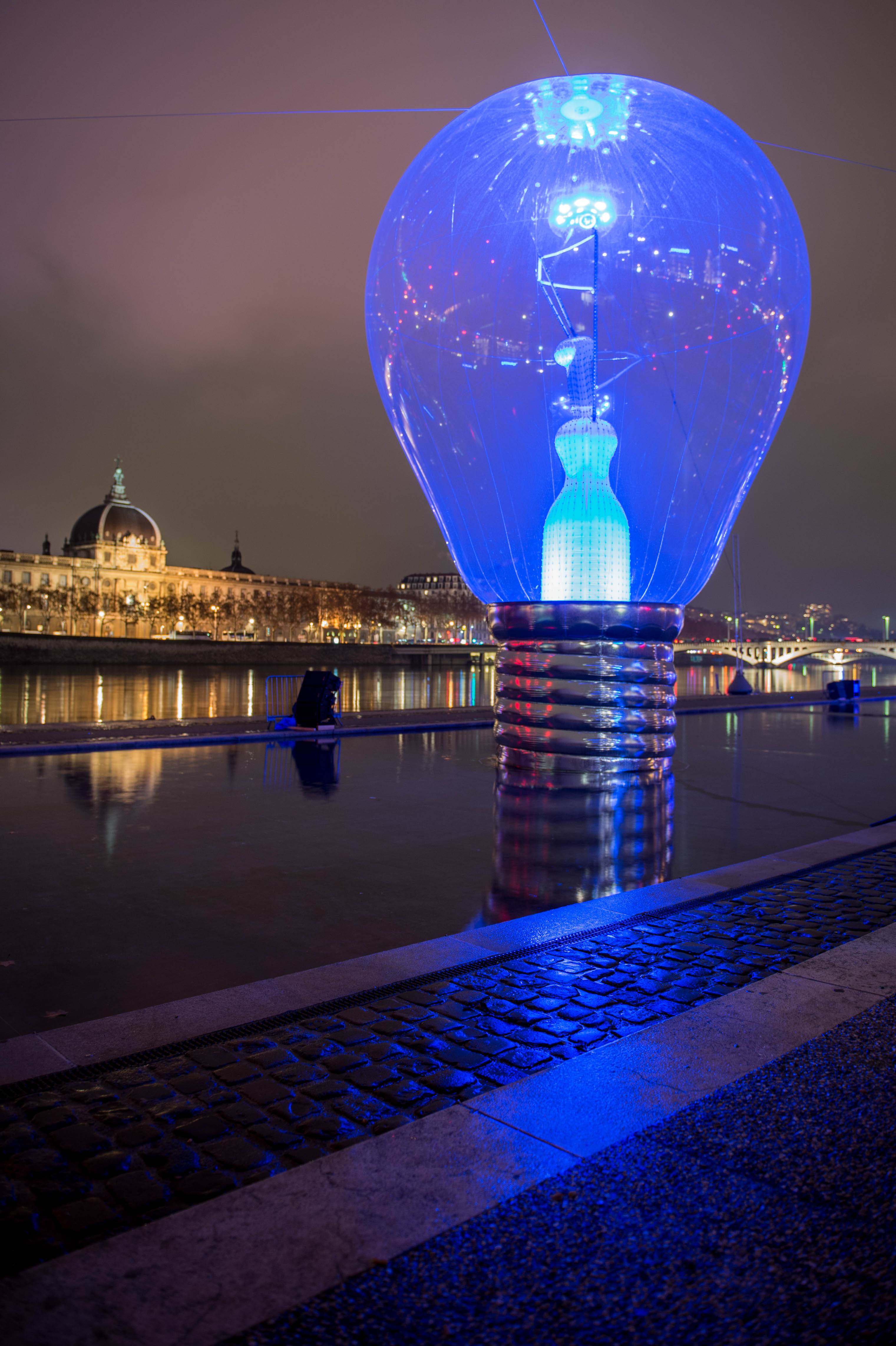
Philips Lighting collaborated with French artist Severine Fontaine, to create the centre piece for the 2014, Lyon Festival of Light. The world famous Festival of Lights in Lyon, France is the world's principal creative lighting display event. This year the show ran from the 5th-8th December.
The six minute, centrepiece show, spanned 80 metres of the River Rhone's banks. The phenomenal centrepiece, named "Incandescence" celebrated the importance of light in human development.
"Incandescence" took six years to create, it featured nine illuminated domes, shaped like incandescent light bulbs.Each dome was the size of a small family car. The six minute show explored the symbiotic relationship between the human race and light. The iconic incandescent light bulb was used to represent the historic relationship between humans and artificial light, exemplifying it's often forgotten impact on human development.
"Incandescence's" co-creator, Severine Fontaine said: "I chose to work with Philips, which is a prestigious partner, providing high-quality and high-tech products that enable spectacular light effects. The Philips technology allowed me to explore and create emotion, working light with great delicacy as if it were a musical score. Philips provided more than just products, the team also bought passion that allowed me to realize my concept and light scenario in optimal condition for the artistic quality of the art work."
Subscribe to:
Posts (Atom)